By Daniel Rowles, lead trainer at Target Internet and author of Digital Branding (Kogan Page). Last updated: November 2026.
Social media is still growing, but more slowly than it used to. According to DataReportal, there were 5.81 billion social media user identities worldwide at the start of October 2026, with 151 million added over the previous year, annual growth of 2.7 percent. Facebook, Instagram, YouTube and WhatsApp remain the most widely used platforms, while TikTok continues to expand its reach. For marketers, the more useful question is not which network is growing fastest, but which one your audience actually uses.
We have published versions of this article every year or two since 2018. This update brings them together into one guide, with the latest data and a practical way to decide where to focus.
How fast is social media growing?
DataReportal's latest analysis says close to 7 in 10 people on Earth now use social media each month, and the typical internet user spends 19 hours and 18 minutes a week on social platforms. Growth has slowed simply because most people who are online already use social media: DataReportal estimates that 94.5 percent of internet users now do so.
Note that these are "user identities" rather than unique people, because some people have more than one account. That is one reason different sources give different answers about which platform is biggest or growing fastest.
Which are the most used social media platforms?
There are two ways to measure size: how many people say they use a platform, and how many people platforms report their adverts can reach.
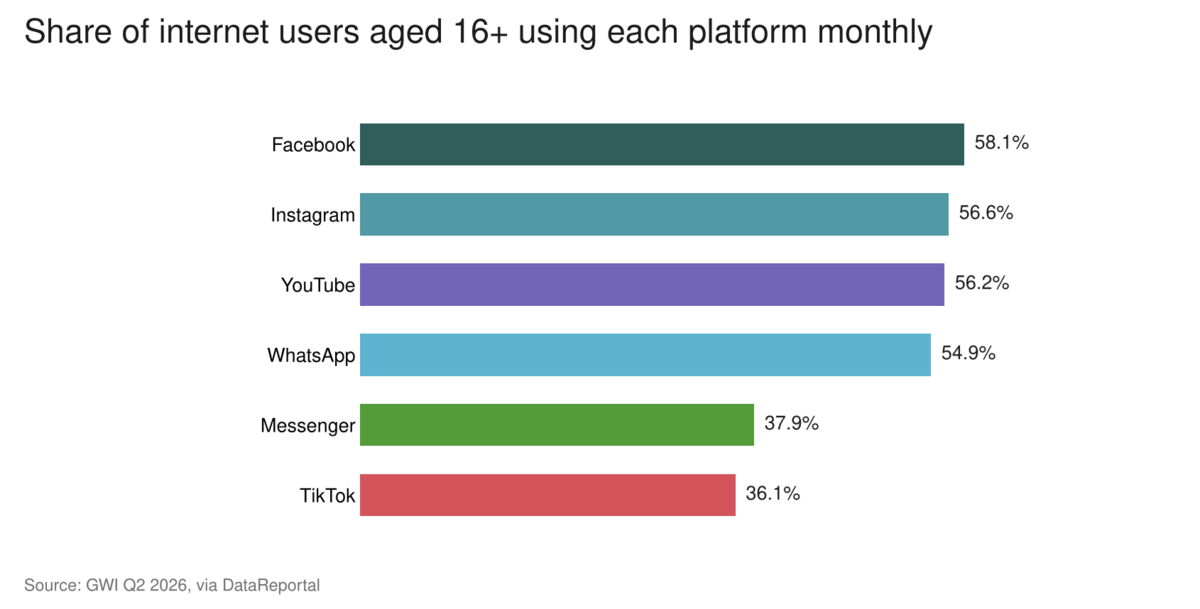
In GWI's Q2 2026 survey, reported by DataReportal, 58.1 percent of internet users aged 16 and over said they used Facebook in the past month, just ahead of Instagram at 56.6 percent and YouTube at 56.2 percent. WhatsApp followed at 54.9 percent, Messenger at 37.9 percent and TikTok at 36.1 percent.
On advertising reach, YouTube reports the largest audience, at 2.77 billion users a month according to DataReportal's analysis, ahead of TikTok at 2.33 billion and Facebook at 2.32 billion. DataReportal notes that Meta appears to have removed a significant number of accounts from its ad audiences recently, which affects these comparisons.
Which social networks are growing fastest?
Over the past few years, the pattern has been consistent. Short-form video platforms, led by TikTok and followed by Instagram Reels and YouTube Shorts, have captured the most attention. Messaging apps such as WhatsApp have become more important for both personal and business communication. Facebook remains enormous but is no longer where most growth comes from, particularly among younger users.
Newer networks regularly attract attention. Earlier versions of this article highlighted BeReal, which grew quickly in 2022 before interest faded, and platforms such as Threads and Bluesky have since emerged as alternatives to X. Rapid early growth does not always last, so it is worth watching new platforms without rushing to invest heavily.
Growth also varies hugely by country and age group. For audience-specific data, our article on how different age groups use social media is a useful companion.
How should marketers choose which networks to use?
A platform's size or growth rate tells you little about whether it is right for your brand. Four questions matter more.
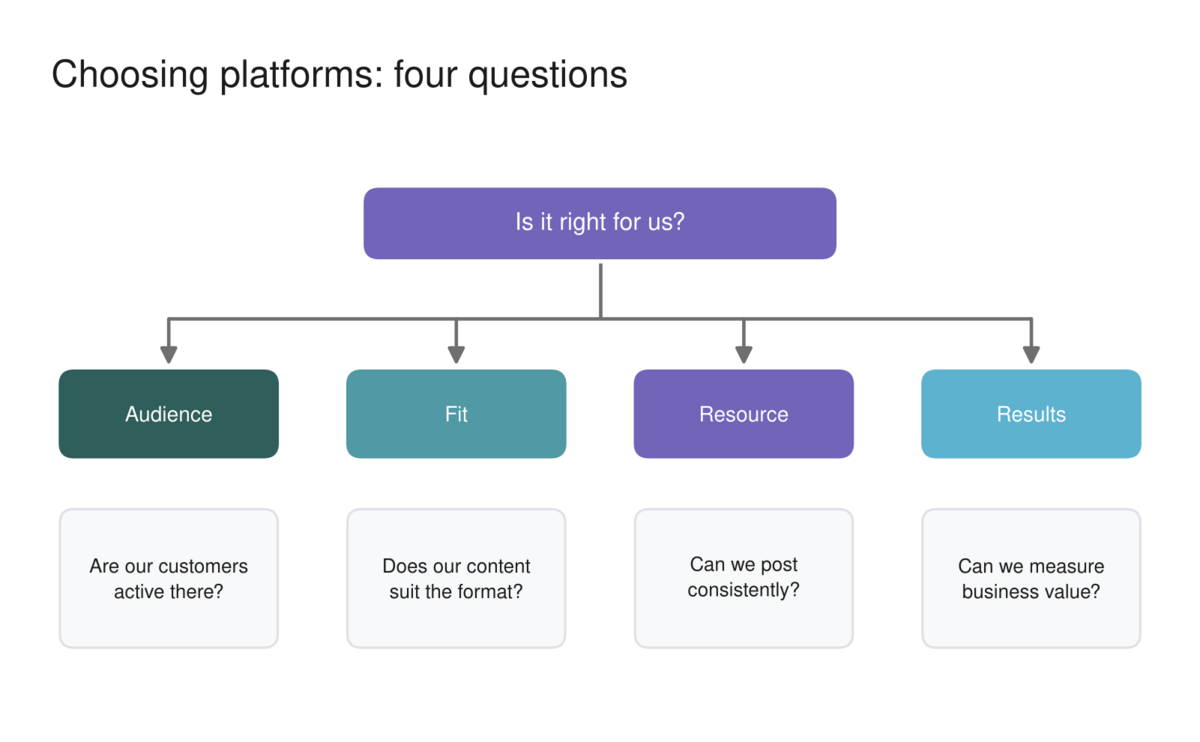
- Audience: are your customers active there, and in what mindset?
- Fit: does your content suit the format, whether that is short video, images, long posts or messaging?
- Resource: can you create content consistently enough to succeed?
- Results: can you measure the value it creates for your business?
It is usually better to do two or three platforms well than to spread thinly across many. The honeycomb model of social media is a helpful way to think about what different platforms offer users, and our guide to delivering a successful social media strategy covers the planning process.
Copy and paste prompt: "Act as a social media strategist. Our business is [describe business] and our target customers are [describe audience, including age, location and job role if B2B]. We currently use [platforms]. Recommend which two or three social platforms we should prioritise and which we should reduce or stop, explaining your reasoning using audience fit, content fit, resource needed and how we would measure results. List the data I should check to confirm your recommendations."
The Target Internet platform can help you build these skills, with interactive courses across digital marketing and AI, skills benchmarking to show where your gaps are, accredited certification, over 400 episodes of the Digital Marketing Podcast, and monthly live masterclasses.
Frequently asked questions
What is the fastest growing social media platform?
There is no single definitive answer, because sources measure growth differently. Over recent years, TikTok and short-form video features on Instagram and YouTube have seen the strongest growth in attention.
What is the most used social media platform?
In GWI's Q2 2026 survey, Facebook was the most used, narrowly ahead of Instagram and YouTube. On reported advertising reach, YouTube has the largest audience.
How many people use social media?
DataReportal reported 5.81 billion social media user identities worldwide in October 2026, close to 7 in 10 people on Earth.
Should my brand be on every social network?
No. Focus on the platforms where your audience is active and where you can create content consistently, and measure the results.
If you are ready to take a structured approach to building your digital marketing skills, explore Target Internet membership options and discover how interactive courses, benchmarking tools, the podcast, accredited certification and live masterclasses can support you and your team.
About the author
Daniel Rowles is lead trainer at Target Internet, a Senior Lecturer at Imperial College and the author of several books on digital marketing published by Kogan Page, including Digital Branding. He co-hosts The Digital Marketing Podcast and delivers digital marketing and AI training for organisations around the world. You can find out more on his Target Internet profile.
Bibliography
1. DataReportal. Global social media statistics. https://datareportal.com/social-media-users