This review is part of our SEO tools comparison report. This article has been updated for 2026 and replaces the older review of Raven Tools.
Index
- Introducing the Tool
- Setup & Interface
- Dashboard & Reporting
- SEO Research Tools
- Link Building
- Competitor Research
- Keyword Research
- Social Media & Ads
- Content Management
- Event Manager & CRM
- White Label Solutions
- Pricing
- Conclusion
- FAQs
Introducing the Tool
Raven Tools is an SEO and marketing reporting platform that's been around since 2007, making it one of the older players in the space. Now owned by TapClicks, the platform positions itself as an all-in-one toolkit combining SEO auditing, link building, competitor research, rank tracking, and, perhaps most notably, a genuinely impressive reporting engine that pulls data from over 30 third-party integrations.
We'll be honest: we didn't expect much going in. The branding feels dated, and Raven doesn't have the marketing presence of Semrush or Ahrefs. But after spending time with the platform, we came away genuinely surprised. Raven Tools focuses on workflow management, data aggregation, and client reporting in a way that makes considerable sense for agencies managing multiple SEO campaigns.
What sets Raven apart is its underlying philosophy. Rather than building proprietary databases for everything, it pulls authority metrics from Moz and Majestic, keyword data from Google's APIs, and lets you connect virtually any marketing platform you're already using in your stack. The result is a centralised command centre rather than a standalone research tool. For agencies juggling Google Analytics, Search Console, social platforms, and paid advertising alongside SEO, this approach removes a significant amount of tab-switching and manual data consolidation.
That said, if you're looking for the keyword research depth of Semrush's 27 billion keyword database or Ahrefs' backlink index of 35 trillion links, Raven isn't trying to compete there. It's a different tool designed for a different workflow, and understanding that distinction is key to knowing whether it's right for you.
Setup & Interface
The first thing you notice about Raven Tools is that the interface feels... functional.
There's no visual polish here - no gradients, no modern card-based layouts, no animations. It looks like a tool built in 2012 and maintained rather than redesigned. And yet, after using it for a few days, we found ourselves appreciating the simplicity. Things load quickly, navigation is predictable, and there's no hunting through nested menus trying to find where a feature has been hidden. All in all, it is very intuitive.
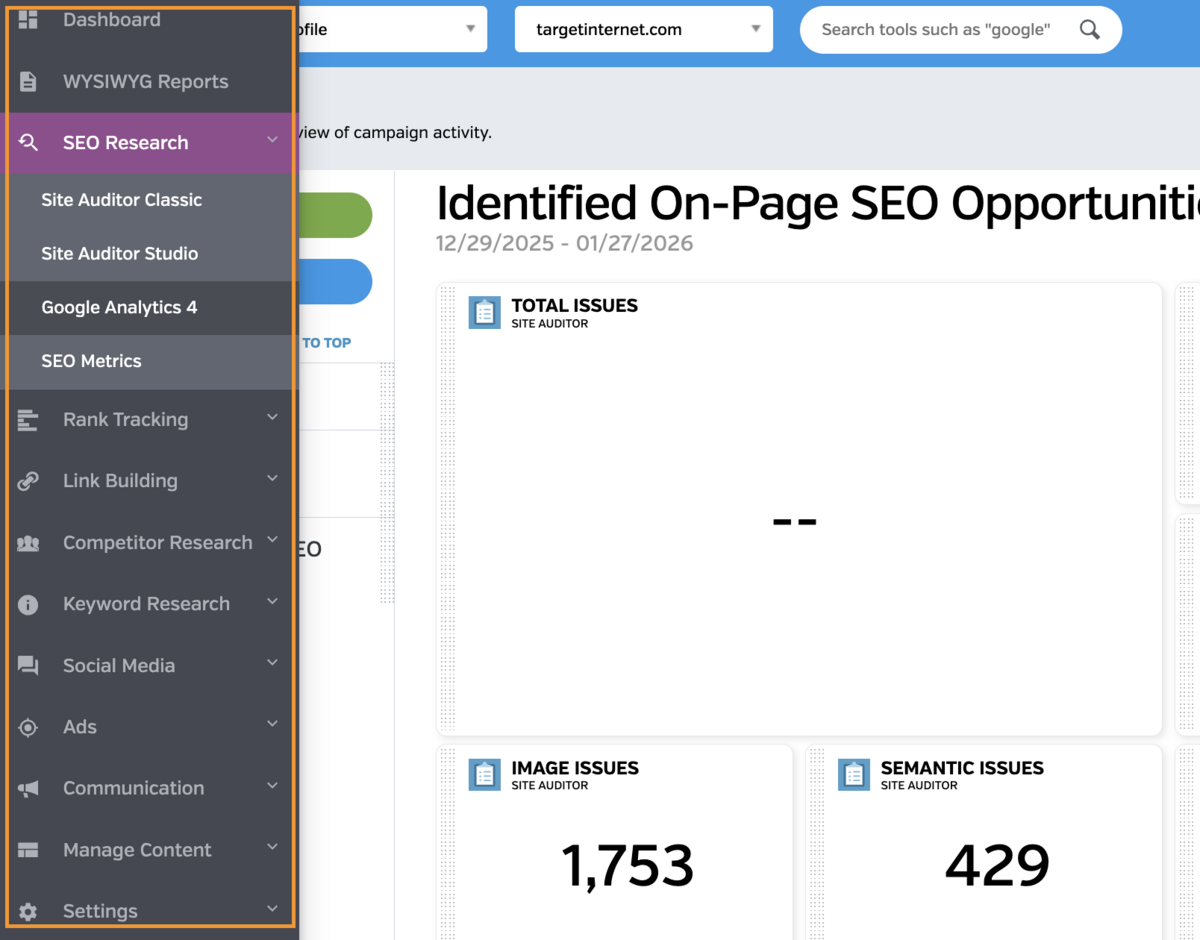
Similar to other SEO tools, the platform organises everything around "Campaigns," which essentially represent individual domains or client projects. Within each Campaign, you'll find a consistent left-hand menu covering Dashboard, Reports, SEO Research, Link Building, Competitor Research, Keyword Research, Social Media, Ads, and Content Management.
What we particularly appreciate is how little friction there is. You can connect Google Analytics, Search Console, and social accounts within minutes, and data starts populating immediately. There's no waiting for crawls to complete before you can access anything useful - the integrations pull live data as soon as they're authorised.
The interface could feel a bit jarring if you're coming from Semrush or Ahrefs. Those platforms have invested heavily in visual presentation; Raven clearly hasn't. Whether that bothers you depends on your priorities. If you value speed and clarity over polish, Raven definitely delivers on that front. If you need to share your screen and show the platform to your clients or stakeholders in a meeting, the dated appearance could make you look like you're using an outdated tool. However, the white-label reporting feature (which we'll cover later) largely solves that problem.
Dashboard & Reporting
This is where Raven genuinely shines, and it's the reason many agencies subscribe to this tool in the first place.
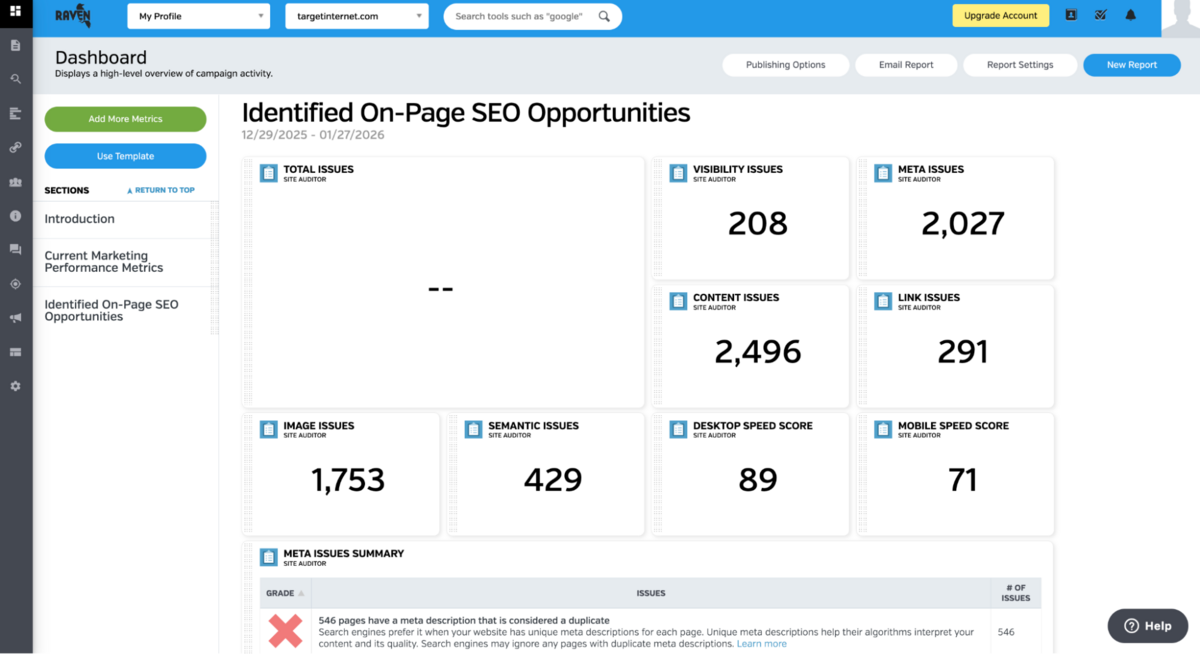
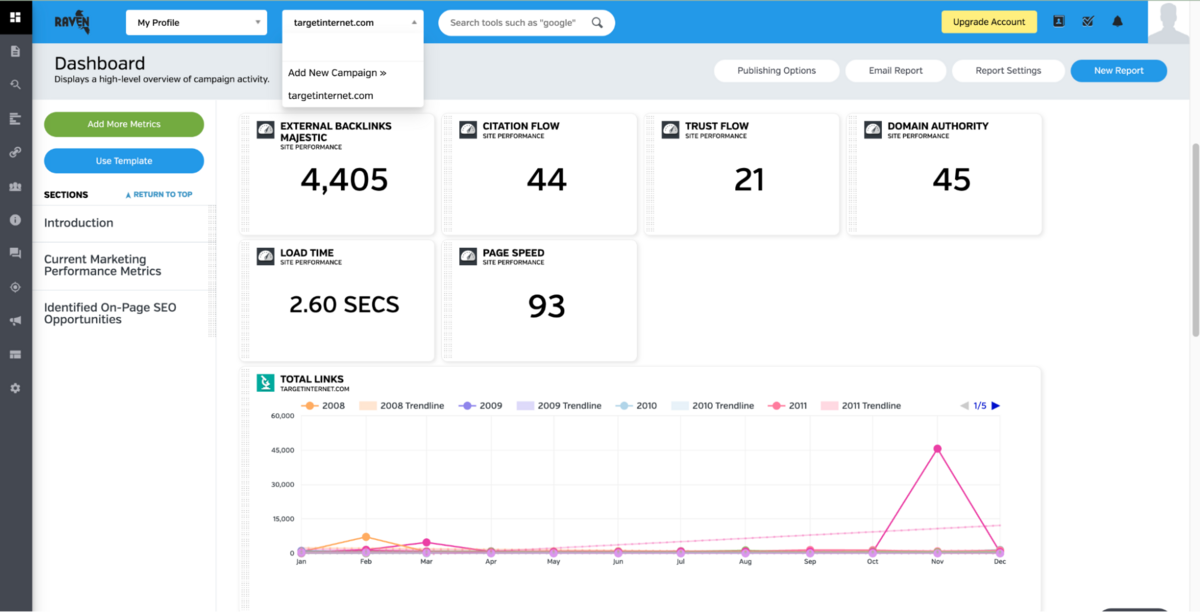
The Dashboard provides an at-a-glance view of your campaign's key metrics, pulling together data from whichever integrations you've connected. What makes it particularly useful is the customisations - you can add or remove widgets for Google Analytics, Site Auditor results, Social Metrics, Backlink Data, Rank Tracking, and more. Basically, you can add whatever you want to see when you log in. A super nifty feature when dealing with different types of priorities.
But the real power lies in the WYSIWYG (What You See Is What You Get) report builder.
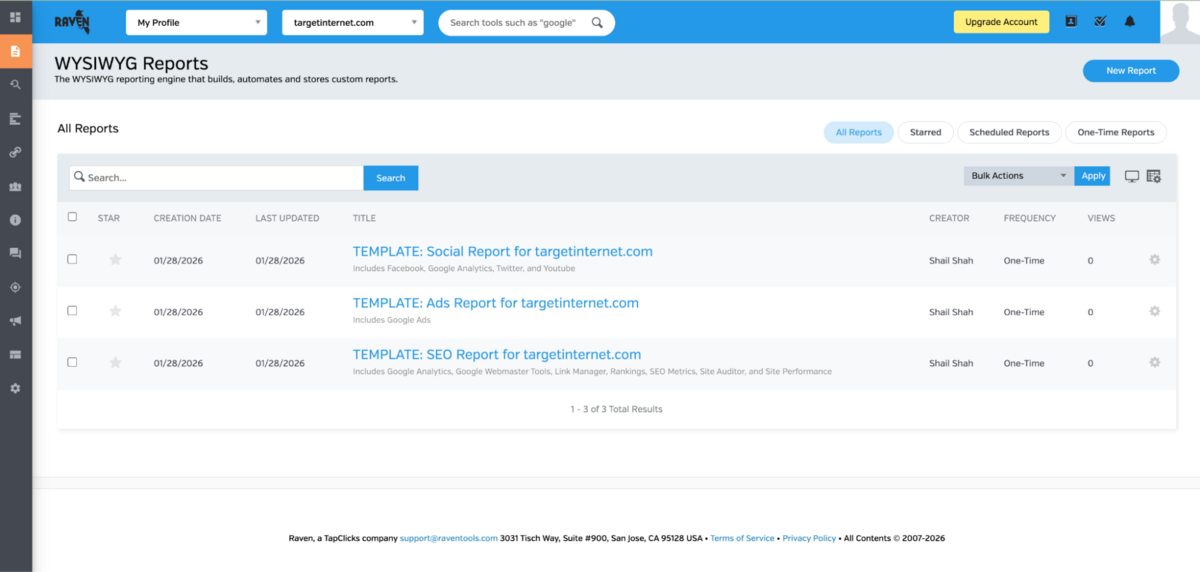
It is one of the most flexible reporting engines we've seen in any SEO platform. You can drag and drop modules from any connected data source, add your own commentary, include logos, and export to PDF or HTML.
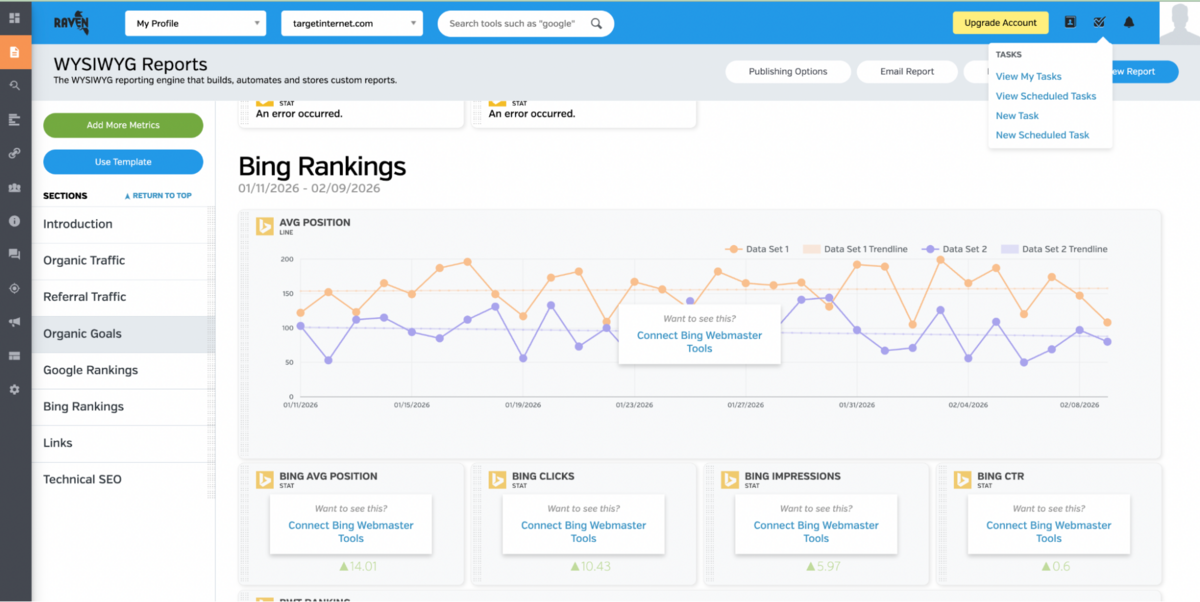
What stands out is how Raven treats reporting as a first-class feature rather than an afterthought. Reporting capabilities in competitors like Semrush and Ahrefs are definitely sophisticated, but Raven Tools wins when it comes to the depth & breadth of reporting. They have thought of every possible use case and made it extremely functional & easy to use.
You can pull backlink data from Majestic, authority scores from Moz, traffic data from Google Analytics, rank tracking from their own system, and social metrics from connected platforms - all into one single, branded report. To give you an idea of how well the reporting section is built, here are all the integrations & data connections Raven Tools allows you to include in your report:
SEO & Analytics: Google Analytics, Google Search Console (Search Analytics), Bing Webmaster Tools, Site Auditor, SEO Metrics, Site Performance, and Research Central.
Link Building: Backlink Explorer (Majestic data), Link Manager, Site Finder, and Website Directory.
Competitor & Keyword: Competitor Manager and Keyword Manager.
Ads/PPC: Google AdWords, Bing Ads, and Facebook Ads.
Social Media: Facebook, Twitter, LinkedIn, and YouTube.
Email Marketing: Email Metrics (Campaign Monitor, MailChimp, EMMA, AWeber, Constant Contact).
Other: Event Manager, Content Manager, WordPress, Authority Labs Import, Text Summary, File Attachment, and Data Import (custom data).
This is the highest number of integrations we have seen any SEO software have - reinforcing how well thought out this tool is.
One user review we came across summarised it well: "The clients loved them, and it gave me some top-level monitoring for a variety of things, even if I'm not focusing on SEO specifically. Having the reports for clients is one of the most useful things for me personally."
If your workflow involves producing regular client reports that aggregate data from multiple sources, Raven's reporting alone might justify the subscription.
SEO Research Tools
Raven's SEO Research section is divided into three core areas: Google Analytics integration, SEO Metrics, and the Site Auditor.
Google Analytics Integration & SEO Metrics
The Analytics integration provides a dedicated view of your traffic data within the Raven interface. You'll see Sessions, Page Views, Pages Per Session, New Sessions, and Bounce Rate - standard metrics, but presented cleanly and easily exportable to reports.
The SEO Metrics section surfaces the key organic data points in one tidy dashboard. It's a quick-reference view rather than a deep research tool.
Site Auditor
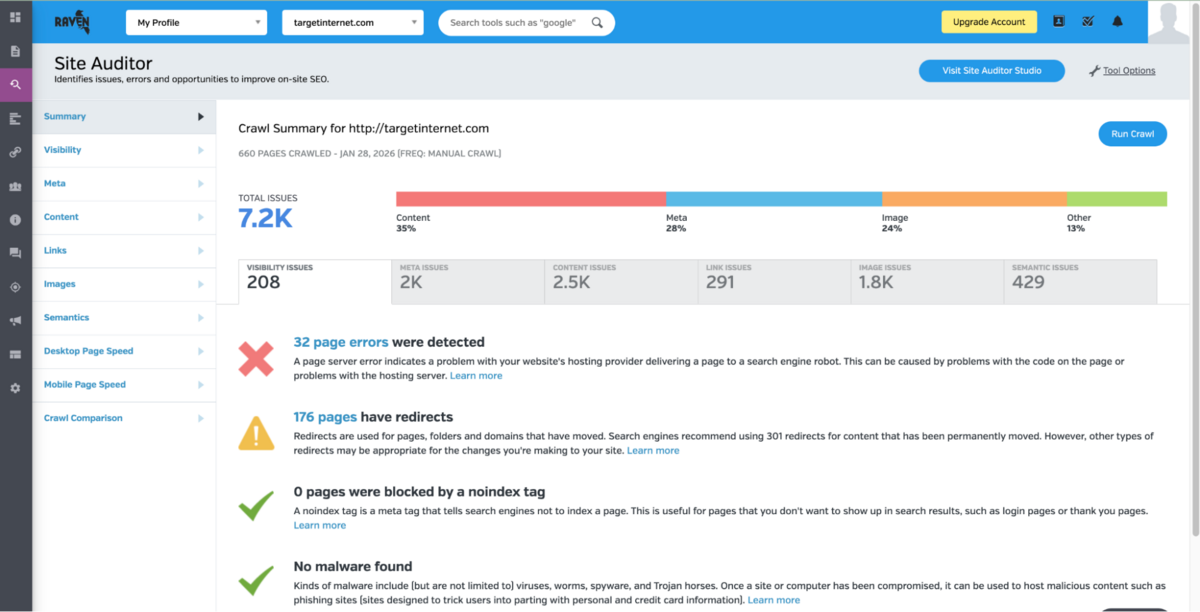
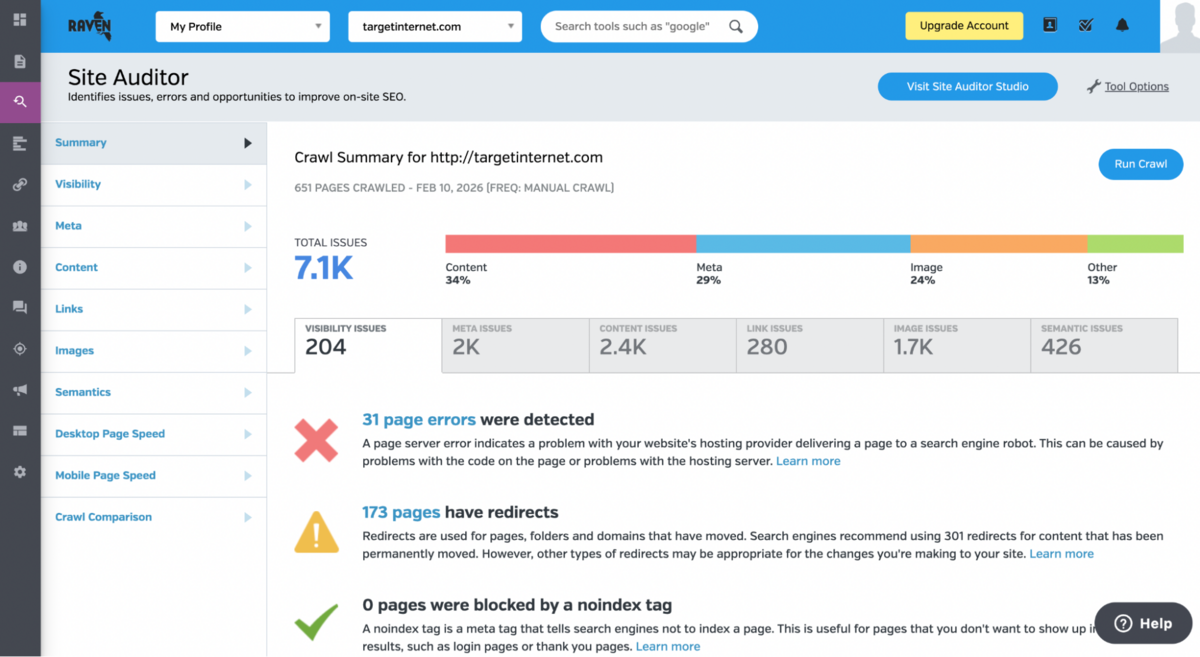
The Site Auditor is one of Raven's more capable native tools, scanning sites for technical SEO issues across several categories:
- Visibility Issues: Redirects, robots.txt problems, malware, server errors
- Meta Issues: Duplicate titles, missing or oversized meta descriptions, analytics gaps
- Content Issues: Duplicate content, thin pages with low word counts
- Link Issues: Broken internal and external links, missing alt text, nofollow problems
- Image Issues: Missing alt text, broken images, oversized files
- Semantic Issues: Schema markup and header structure problems
The newer Site Auditor Studio version adds a few improvements. Issues are now listed by severity, making it considerably easier to prioritise fixes. You can schedule crawls, exclude specific paths, and - this is the part we particularly like - mark errors as "fixed" without waiting for a fresh crawl. It essentially turns the auditor into a task management tool for technical SEO work.
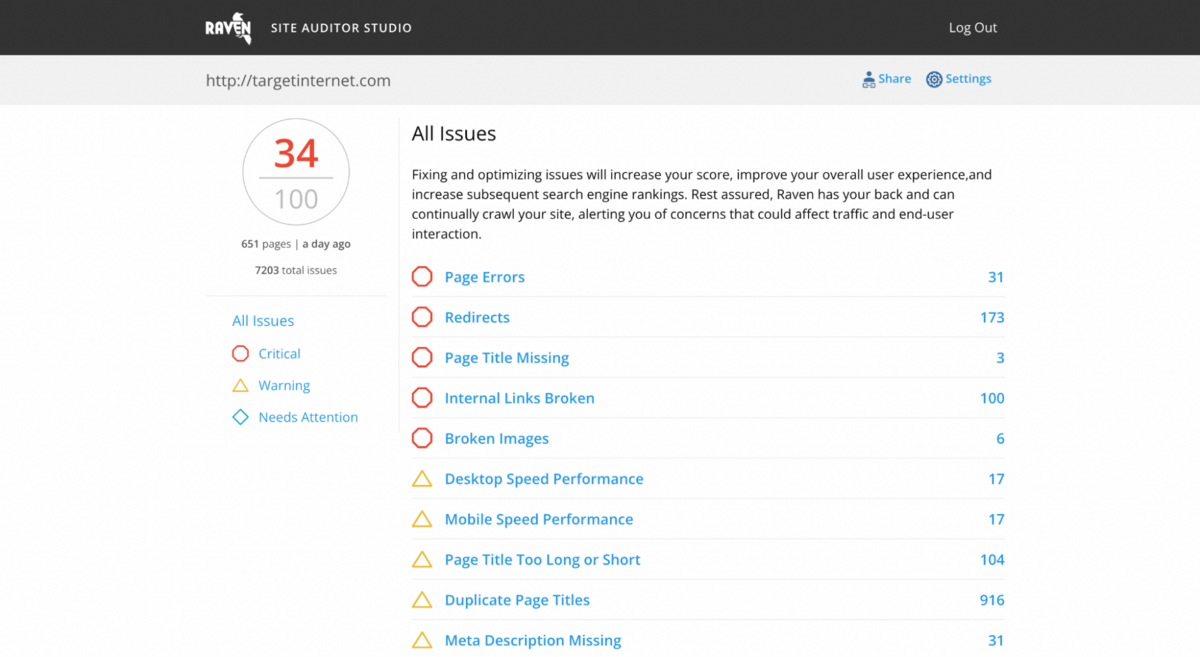
The tool provides a score out of 100 to give you a quick gauge of your site's health, and you can share specific error categories with developers or team members. You could also use this section to quickly do a site audit for a prospective client and use it as a sales asset.
Despite the recent improvements, the Site Auditor doesn't match the depth of Ahrefs' 170+ checks or Semrush's thematic reports. It covers the fundamentals well, but if you're doing enterprise-level technical SEO like log file analysis, JavaScript rendering diagnostics, or Core Web Vitals deep dives, you'll need to supplement with other tools.
Link Building
Raven's Link Building section is solely built around workflow management. It comprises four sub-tools: Link Manager, Backlink Explorer, Site Finder, and Website Directory.
Backlink Explorer
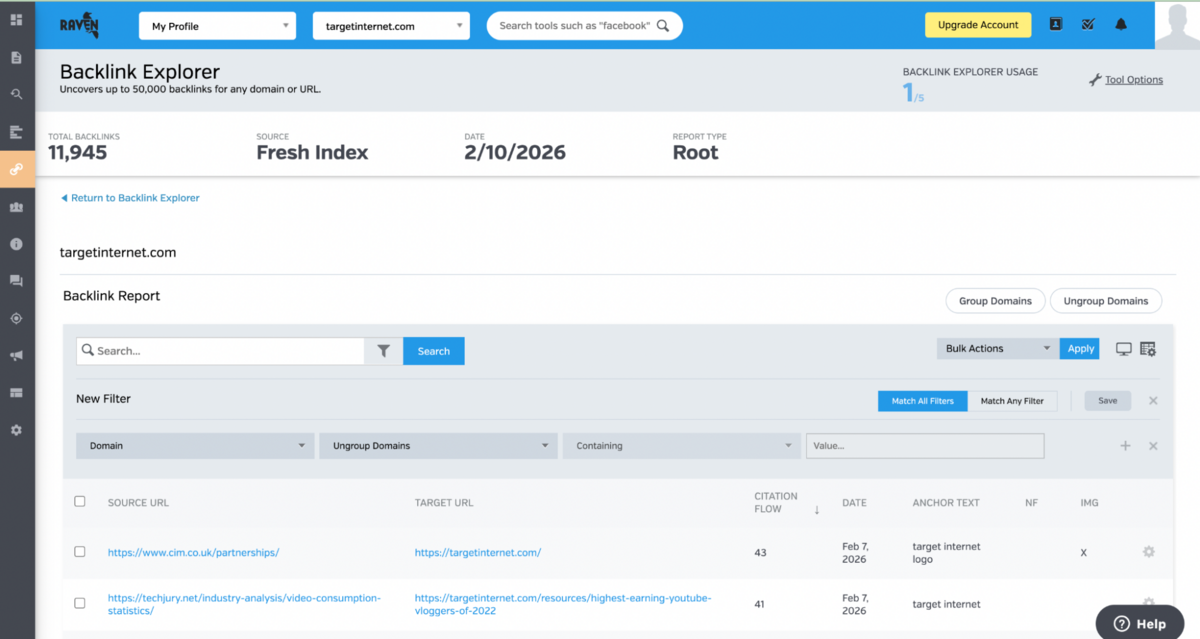
The Backlink Explorer pulls authority metrics and backlink data from Majestic, letting you analyse competitor link profiles and identify opportunities for link-building. You can examine any domain's backlinks, filter by authority, and spot patterns worth pursuing.
Link Manager
Link Manager helps you store and track all your link-building activities in one place. You can save potential link opportunities, record links you've acquired, track your outreach efforts, monitor whether links stay active, and manage the entire link acquisition process.
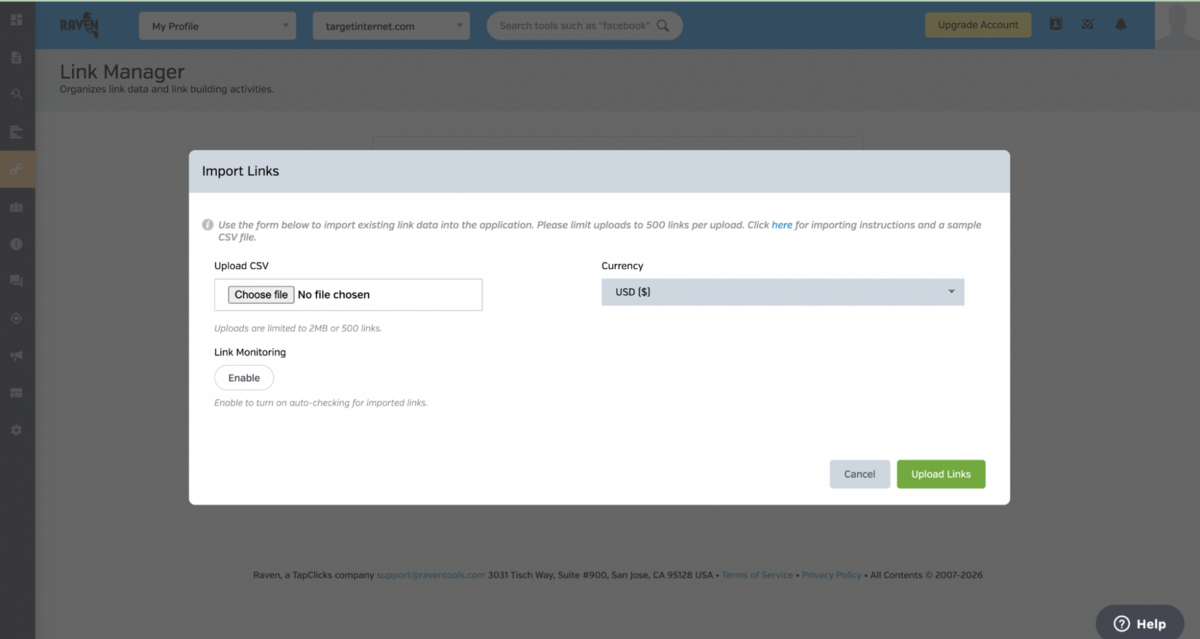
What's particularly clever is the integration with Raven's built-in CRM. You can attach contacts, log communications, set follow-up tasks, and essentially run your entire outreach operation without leaving the platform. When you're doing manual link building at scale, this removes a significant amount of time wasted on juggling tabs & spreadsheets. You can also import links from an Excel file directly into the Link Manager.
The tool also monitors link status and takes screenshots of active links, notifying you if anything changes. If a link gets removed, you'll know about it via a notification, which is valuable when you've invested time and resources into acquiring a link.
Competitor Research
Honestly, Raven's Competitor Research section does not match the depth of Semrush's Keyword Gap or Ahrefs' Content Gap tools. It just gives you the basics in a usable format.
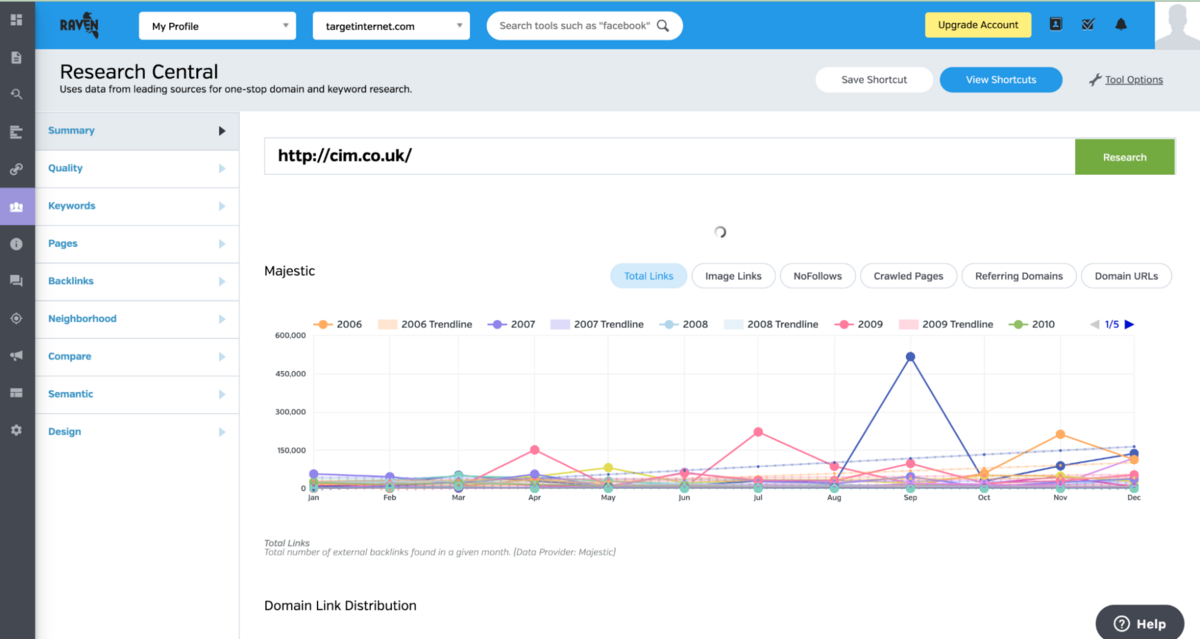
The Site Performance dashboard lets you compare your site against competitors across a range of metrics: External Backlinks (from Moz and Majestic), Citation Flow and Trust Flow (Majestic), Domain Authority, mozRank and mozTrust (Moz), Load Time and Page Speed, and social engagement metrics across Twitter, Facebook, LinkedIn, Pinterest, and more.
The ability to see all of this in a single comparative view is useful for quick benchmarking, though the data itself is pulled from third parties rather than generated by Raven.
Keyword Research
Raven's Keyword Research tools work well for organisation and tracking, though they're not designed for discovery at scale.
Keyword Manager
The Keyword Manager is where you upload, organise, and store keywords that matter to your campaigns. There's no limit to the number of keywords you can save, and you can organise them with tags and filters - by brand terms, content themes, or any categorisation that fits your workflow.
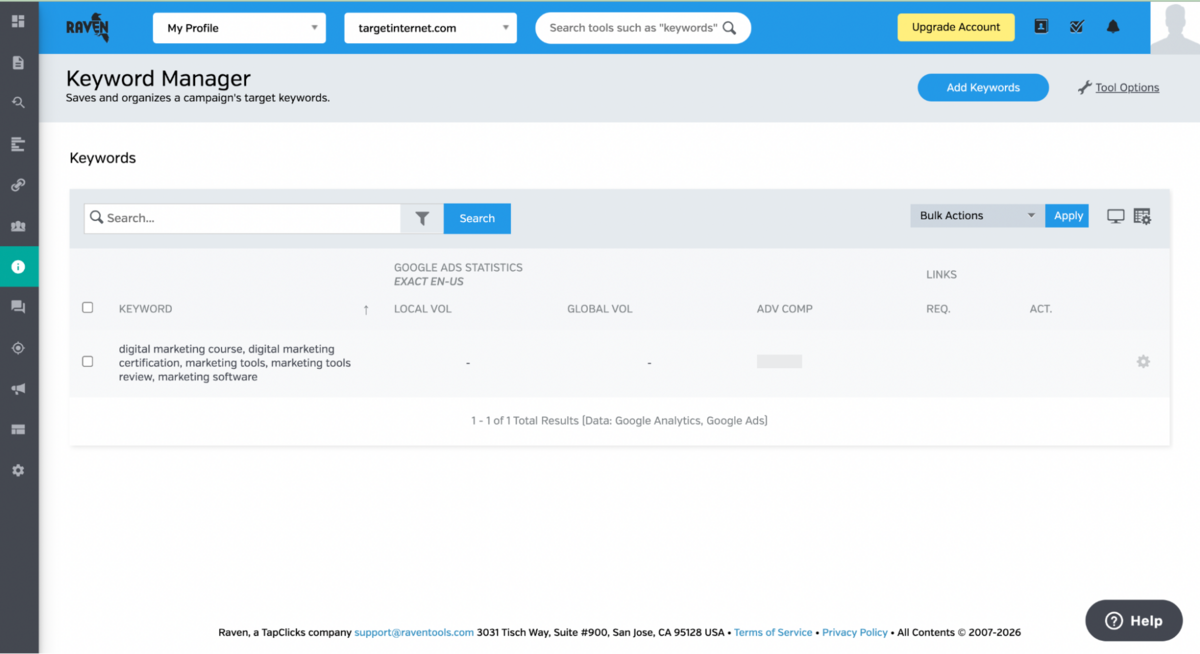
Keywords stored here display data from Google Analytics, AdWords, and Search Console (if authorised), including average rank data.
You can also see how many active links use each keyword as anchor text - a helpful connection between keyword targeting and link-building efforts. The tool supports bulk CSV imports and integrates with Research Central and Search Analytics, so you can send keywords from research directly into your managed lists.
That said, if you need to discover new keyword opportunities, generate thousands of variations from a seed term, or analyse SERP features and intent at scale, you'll find Raven's capabilities limited compared to its competitors. This is a keyword management tool, not a keyword research engine.
Social Media & Ads
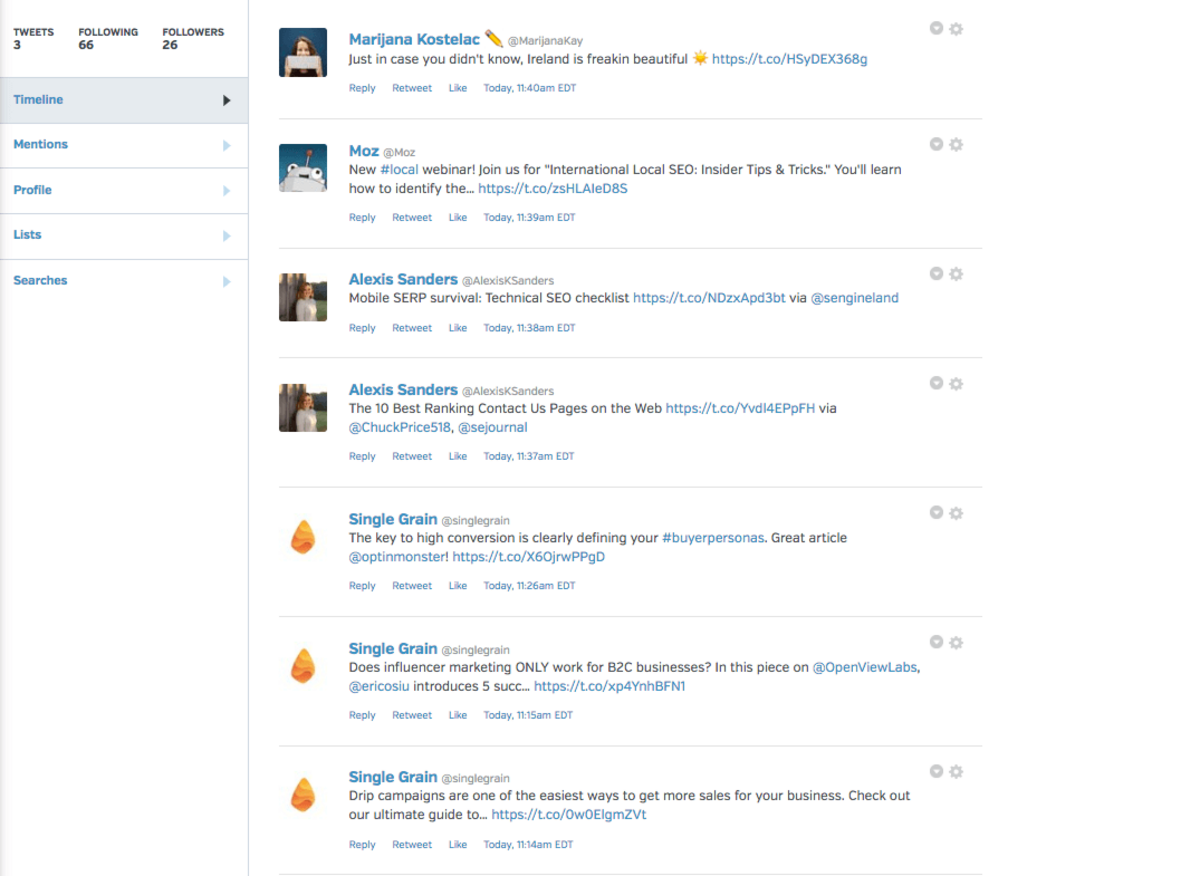
Raven includes integrations for Twitter, Facebook, YouTube, LinkedIn, Google Ads, Bing Ads, and Facebook Ads - allowing you to view social timelines, track mentions, and monitor ad performance all within the platform.
The Social dashboard aggregates your feeds and metrics in one place, which is helpful for reducing context-switching. You can track mentions, connections, and referral traffic, then pull everything into your reports. If you're also doing social reporting alongside SEO, this is a sweet add-on.
The Ads section provides visibility into Google Ads, Facebook Ads, and Bing Ads campaigns with breakdowns by performance, schedule, geographic location, and top performers. You can also see metrics like impressions, clicks, costs, and conversions segmented by network, device, ad slot, day of week, and time of day.
You can't create or manage ad campaigns in Raven Tools. Instead, it helps you understand how your ad campaigns are performing on different platforms, especially when viewed alongside site traffic metrics.
If you've ever manually pulled data from multiple sources to build a presentation or brief your team, you know how time-consuming this can get. Raven Tools eliminates that hassle by automatically creating the dashboard for you - consolidating all your advertising data in one place.
Content Management
Raven's content management features are focused on 2 parts of the workflow - optimisation and publishing.
The Manage Content tool gives you a site score, document score, and readability score based on your target keywords. You can create content, write meta descriptions, preview SERP appearance, and analyse structure all within the same interface.
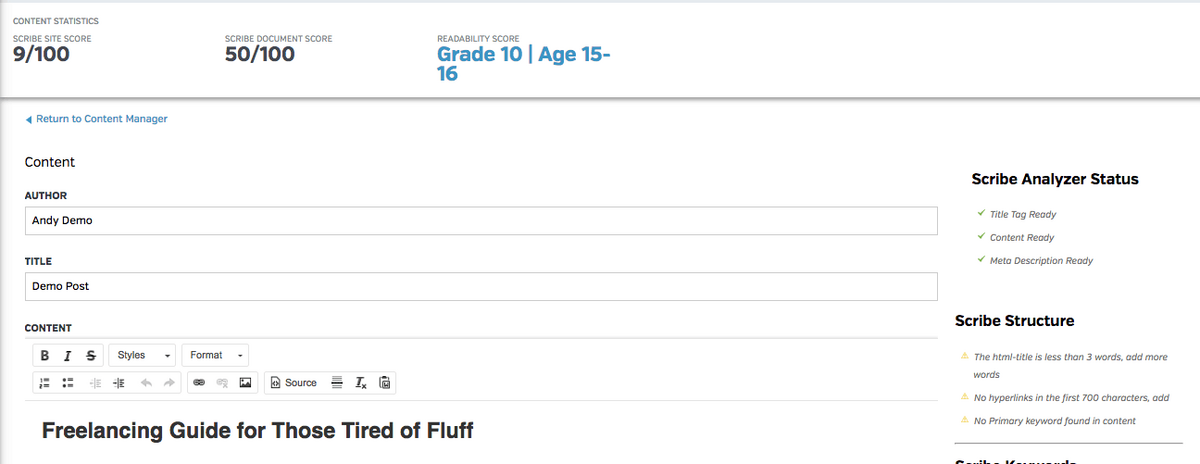
The WordPress integration lets you publish directly from Raven, which is helpful if you're managing content across multiple client sites. You can also connect to Textbroker if you need to outsource content creation.
What's notably missing compared to Semrush's version of this tool is an AI writing assistant or content brief generator. Semrush's SEO Writing Assistant provides real-time feedback on keyword usage, readability, and tone of voice with a Google Docs plugin.
Event Manager & CRM
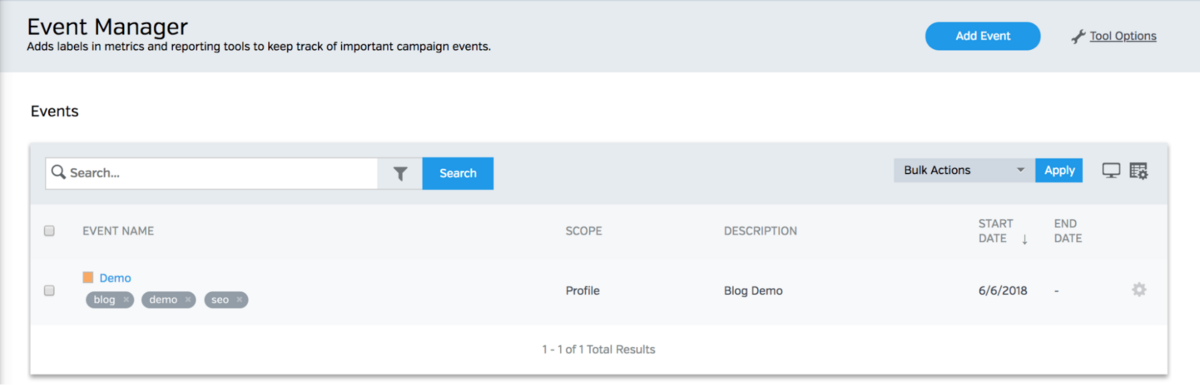
One of Raven's underappreciated features is its built-in Event Manager and CRM.
The Event Manager lets you log important dates - site launches, server downtime, algorithm updates, major content changes - and those events appear visualised on every graph and chart in the tool. This makes it considerably easier to correlate ranking or traffic changes with known events, rather than trying to remember what happened three months ago when investigating a traffic dip.
The CRM is tightly integrated with the link-building workflow. Since link acquisition is fundamentally about relationships, Raven lets you track contacts, log communications across email, phone, and social, assign follow-up tasks, and manage the entire outreach process.
White Label Solutions
Raven offers comprehensive white-label options that genuinely set it apart for agency use: custom branding on all reports with your logo and colours, a custom domain so clients access the platform through your URL, and an embedded login portal that you can integrate into your own website.
Your clients never need to know you're using Raven. The reports look like proprietary deliverables, the login experience can be branded entirely as yours, and the underlying platform disappears behind your agency's presentation.
Pricing
Raven Tools' pricing is competitive - arguably one of the most affordable entry points for an all-in-one SEO and reporting platform, particularly when you consider the number of domains and users included at each tier.
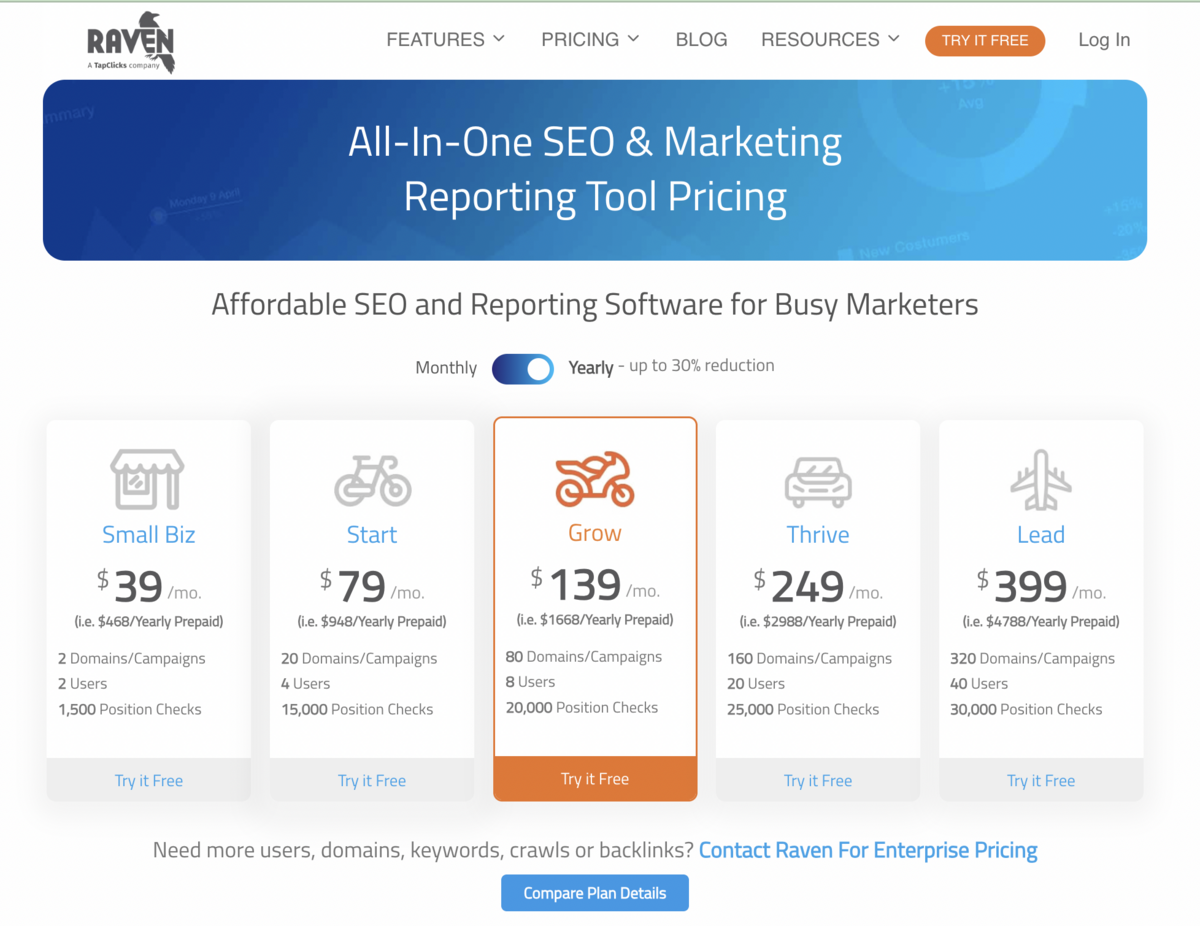
The pricing structure scales based on three key variables: Campaigns/Domains, Users, and Position Checks. All plans include access to the same 45 tools and integrations - the difference is purely capacity.
| Feature / Plan | Small Biz | Start | Grow | Thrive | Lead |
|---|---|---|---|---|---|
| Monthly Price | $39/mo | $79/mo | $139/mo | $249/mo | $399/mo |
| Yearly Prepaid | $468/yr | $948/yr | $1,668/yr | $2,988/yr | $4,788/yr |
| Campaigns/Domains | 2 | 20 | 80 | 160 | 320 |
| Users Included | 2 | 4 | 8 | 20 | 40 |
| Position Checks/mo | 1,500 | 15,000 | 20,000 | 25,000 | 30,000 |
| Monthly Page Crawls | 50k | 400k | 2 Million | 5 Million | 7 Million |
| White Label | Subdomain | Subdomain | Full | Full | Full |
| Automated Reports | Unlimited | Unlimited | Unlimited | Unlimited | Unlimited |
What stands out immediately is the user and domain allocation. At $79/month, the Start plan includes 20 domains and 4 users. Compare that to Semrush, where additional users cost $45/month each, or Ahrefs' Standard plan at $249/month, which includes 1 user with extras at $60/month each. For agencies managing multiple clients with small teams, Raven's economics make considerably more sense.
All plans include the core reporting, CRM, site auditor, and integration capabilities. The Grow tier and above unlock Full White Label options, including custom domains - essential for agencies that want to present a fully branded experience to clients.
Conclusion
Raven Tools occupies an interesting position in the SEO software landscape.
One clear thing is that Raven Tools is built for agencies & people who already have experience in SEO. Think of it like the Google Ads Editor. Not so great in UI, but definitely the most efficient way to edit & manage ads. Sure - Google Ads' platform is way more intuitive & friendly for beginners, but you can complete the same tasks on the editor in 3x less time. That's what Raven Tools is - it is not built for beginners. It is built for agencies with large client portfolios that need to be efficient in what they do and manage large-scale projects.
When you're managing multiple clients who need consolidated reporting across SEO, social, and paid channels, Raven delivers genuine value. The white-label options are comprehensive, the CRM integration is thoughtfully designed, and the reporting engine is one of the most flexible ones we've seen.
Here's the simple breakdown: if you're on the brand side, go with Semrush, Moz Pro, or Ahrefs - tools with better interfaces, deeper feature sets, and more educational resources for teams that want to manage every aspect of SEO in-house. But if you're on the agency side, juggling multiple clients and need to execute the core SEO deliverables efficiently, Raven Tools stands out with its streamlined feature set, white-label reporting, workflow management, and affordable pricing. Tools like Ahrefs and Semrush are undeniably more powerful, but Raven isn't trying to compete on depth - it's competing on operational efficiency, and for agencies with large client portfolios, that's often exactly what matters most.
It's a tool that knows what it is, and executes on that vision consistently.
Go back to the SEO tools comparison report.
Frequently Asked Questions (FAQs)
What is Raven Tools?
Raven Tools is an SEO and marketing reporting platform that aggregates data from over 30 integrations - including Google Analytics, Search Console, Moz, Majestic, and major social and advertising platforms - into a single dashboard with powerful reporting capabilities. It's particularly popular with agencies for client reporting and campaign management.
Who owns Raven Tools?
Raven Tools is owned by TapClicks, a marketing operations platform company. The tool has been operating since 2007 and was acquired by TapClicks to complement their broader marketing analytics suite.
Is Raven Tools good for keyword research?
Raven Tools provides basic keyword research functionality through its Research Central and Keyword Manager tools, pulling data from Google's APIs. However, if keyword research is central to your workflow, you'll likely want a dedicated tool like Semrush or Ahrefs alongside Raven - the depth and discovery capabilities don't match those platforms.
Does Raven Tools have its own backlink database?
No. Raven Tools pulls backlink data from Majestic and authority metrics from Moz rather than maintaining its own proprietary index. This means you're getting third-party data through Raven's interface and workflow tools.
What's the best use case for Raven Tools?
Raven Tools is best suited for agencies managing multiple clients who need consolidated reporting across SEO, social media, and paid advertising channels. The white-label reporting, built-in CRM, and workflow management features are its primary strengths.