By Daniel Rowles, lead trainer at Target Internet and author of Digital Branding (Kogan Page). Last updated: November 2026.
The exponential growth of technology means capability does not improve by the same amount each year: it multiplies. Moore's Law is the best-known example. In 1965 Gordon Moore predicted that the number of transistors on a chip would keep doubling, and chips went from 2,300 transistors in 1971 to hundreds of billions today. For marketers, it explains why change keeps feeling faster.
This guide explains what Moore's Law is, how exponential growth works, whether Moore's Law still holds, and why AI has become the new example of exponential change. It finishes with practical ways marketers and their teams can plan for technology that keeps accelerating, from building learning into everyday work to running small experiments. For where we think things are heading next, see our digital marketing trends for 2027 session.
What is Moore's Law?
Moore's Law is an observation, not a law of physics. In an article published in Electronics magazine on 19 April 1965, Gordon Moore, then director of research and development at Fairchild Semiconductor, noted that the number of components on an integrated circuit had been doubling every year. He extrapolated that trend forward a decade. According to Live Science, Moore revised his prediction in 1975 to a doubling every two years, and that pace held roughly true for around the next 40 years.
Moore co-founded Intel in 1968, and the company's first microprocessor, the 4004, launched in 1971 with 2,300 transistors. Moore died in 2023, but the idea that bears his name became one of the most influential forecasts in business. As Live Science notes, one reason it worked so well is that it became a target the chip industry planned around, making it partly a self-fulfilling prophecy.
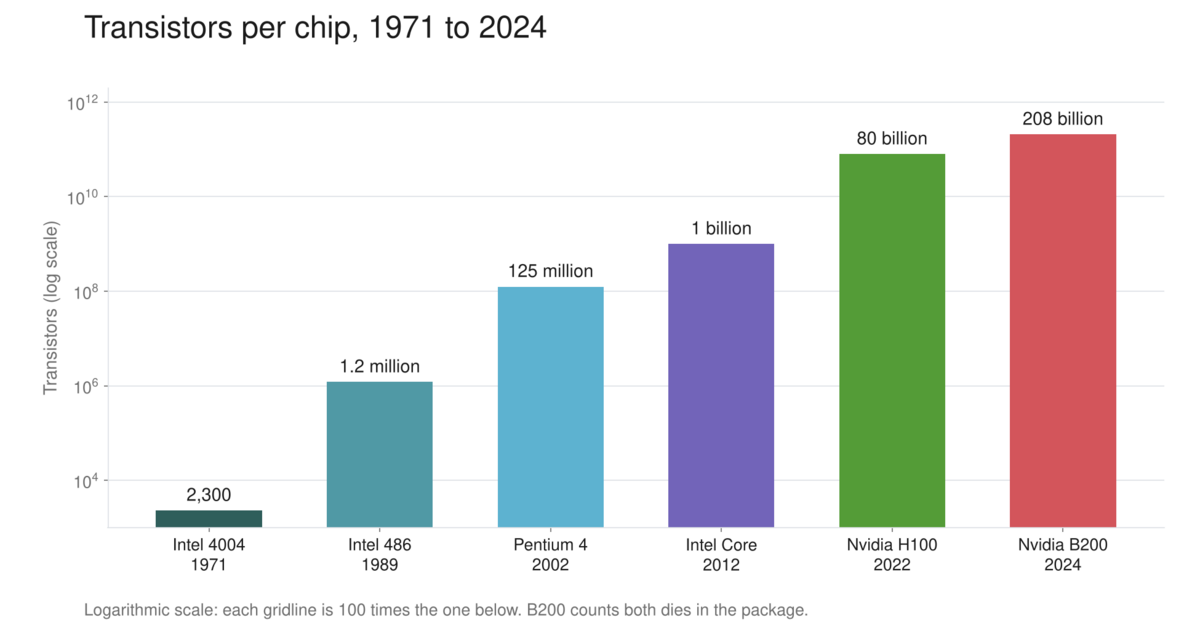
The numbers are hard to grasp. The Intel 486 passed one million transistors in 1989, and Intel reached one billion on a mainstream Core processor in 2012. Nvidia's B200 AI accelerator, announced in 2024, packs 208 billion transistors across two connected dies, compared with 80 billion on its predecessor, the H100.
What is exponential growth?
Exponential growth happens when something grows by a fixed percentage over each period, rather than a fixed amount. Because each increase builds on the last, the numbers start small and then rise very quickly.
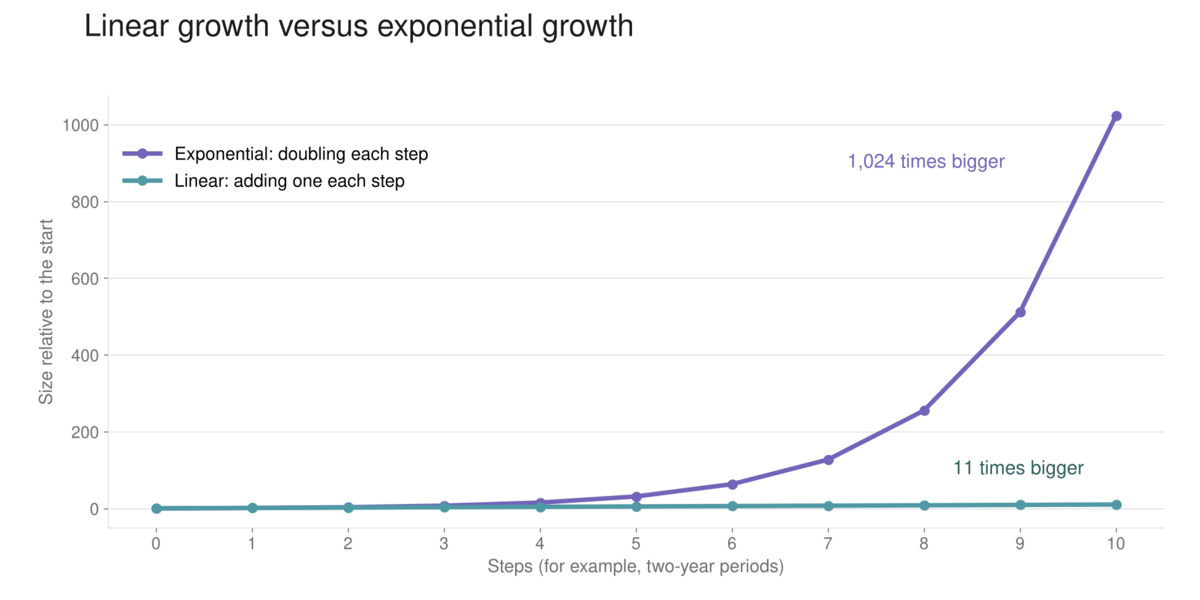
The easiest way to see the difference is to compare adding with doubling. If you add one each step, after ten steps you have 11. If you double each step, after ten steps you have 1,024. For the first few steps the two lines look almost identical, which is exactly why exponential change catches people out.
Why exponential change feels sudden
A classic thought experiment makes the point. Imagine water lilies on a pond that double in area every day and cover the whole pond on day 30. On which day is the pond half covered? Day 29.
For most of the month the lilies are barely noticeable, and then, in the last few days, they take over.
Technology adoption often feels the same way from the inside. A new tool or behaviour seems niche for years, then appears to become mainstream almost overnight. In reality the growth rate was steady all along; it was the absolute numbers that were too small to notice. That is why organisations that wait for a technology to look important before engaging with it are often already late.
The reverse is also true. Once a trend hits a limit, growth can stall just as abruptly, and the hype built on extrapolating the curve forward collapses. Good planning watches both the rate of change and the constraints that could slow it.
Plenty of things grow exponentially for a while: the spread of a virus, compound interest, a piece of content shared from person to person. None of them grow exponentially for ever, because something eventually limits them, whether that is physics, money or the size of the audience. That limit is what is now happening to transistors.
Is Moore's Law still true?
In its strict form, not really. Shrinking transistors has become much harder and more expensive as features approach the scale of individual atoms, and Live Science concludes that the days of doubling transistor counts every two years are behind us. The B200 is a good illustration: AnandTech noted that each of its dies has only about 30% more transistors than the previous generation, a modest gain by historical standards, which is why Nvidia joined two dies together.
But the spirit of Moore's Law, that computing capability keeps compounding, has carried on through other routes: multiple chips working as one, specialised AI processors, better software, and data centres built at enormous scale. Progress has shifted from the single chip to the whole system.
AI is the new exponential
The clearest example of exponential growth in technology today is AI. Epoch AI, a research organisation that tracks AI trends, found that the compute used to train frontier AI models grew by around four to five times a year between 2010 and May 2024. That is far faster than Moore's Law ever was: doubling every two years works out at roughly 1.4 times a year.
This is why AI capabilities that seemed years away keep arriving early, and why marketing tools, search engines and customer expectations are changing faster than most organisations can comfortably absorb. Our guide to optimising content for AI Overviews and AI Mode shows how quickly one of those changes is already reshaping search.
If you want to keep your skills ahead of that change, the Target Internet platform includes interactive courses across digital marketing and AI, skills benchmarking to show where your gaps are, accredited certification, over 400 episodes of the Digital Marketing Podcast, and monthly live masterclasses such as our session on the digital marketing skills in demand.
What does the exponential growth of technology mean for marketers?
Moore's Law is not directly about marketing, but the pattern behind it has four practical lessons.
- The next big change will arrive sooner than the last one took. It is tempting to treat new technology as a problem for later. With exponential change, the gap between step changes shrinks, so it pays to start experimenting early, when a technology still looks immature.
- Skills date faster. A narrow specialism built on a single platform or tool can lose its value quickly. Deep expertise still matters, but it should sit on principles that outlast any one tool: understanding audiences, measurement, content and strategy.
- Small early signals matter. On an exponential curve, the early numbers look unimpressive. When a new channel or tool is growing fast from a low base, watch the growth rate, not the current size.
- You can design for compounding effects. Some marketing assets compound in value: content that keeps ranking and being shared, an email list that grows through referrals, a community that recruits new members. Look for the parts of your marketing where each result makes the next one easier, and invest in those.
Copy and paste prompt: "I work in [role] at [type of organisation]. List five technology changes, including AI, that are likely to affect my work in the next two years. For each one, explain what is changing, the earliest signs I should watch for, one small experiment my team could run in the next month to learn about it, and the skill we would need to build."
How to plan for exponentially advancing technology
No one can predict exactly which technologies will matter in five years. What you can do is build a team that adapts quickly when they arrive. In our work training marketing teams, three habits make the biggest difference.
Build a culture of ongoing learning
Make learning part of the job rather than an occasional event. Give people regular time to explore new tools, ask individuals to brief the team on developments in their area, and celebrate people who bring useful new techniques into the business. Our guide to creating a culture of ongoing learning explains how to set this up.
Work in short, flexible cycles
Long fixed plans struggle when technology changes mid-year. Agile ways of working, which organise work into short sprints with regular reviews, make it easier to test something new, learn from it and change direction. Our introduction to agile working covers the basics for marketing teams.
Run small experiments continuously
Set aside a small, protected budget for testing new channels and tools, with clear criteria for scaling up or stopping. Because exponential trends look small at first, a steady stream of cheap experiments is the most reliable way to spot the ones worth backing before your competitors do.
If you are ready to take a structured approach to building your digital marketing skills, explore Target Internet membership options and discover how the platform's interactive courses, benchmarking tools, podcast, accredited certification and live masterclasses can accelerate where you are heading next.
Frequently asked questions
Does technology grow exponentially?
Many technologies have grown exponentially for long periods. Transistor counts doubled roughly every two years for decades, and the compute used to train frontier AI models has recently grown by around four to five times a year. No technology grows exponentially for ever, though: physical and economic limits eventually slow each trend, and progress moves to new approaches.
What is Moore's Law in simple terms?
Moore's Law is the observation, made by Intel co-founder Gordon Moore, that the number of transistors on a computer chip doubles roughly every two years. More transistors meant faster, cheaper and more capable computers, so it became shorthand for the rapid, predictable improvement of computing technology.
Is Moore's Law dead?
In its strict sense, largely yes. Shrinking transistors is now much harder and more expensive, and transistor counts on a single chip no longer double every two years. Computing power keeps growing in other ways, such as combining several chips, specialised AI processors and larger data centres, so the broader idea of compounding progress continues.
Why is exponential growth hard to understand?
People tend to think in straight lines. Early on, exponential growth looks almost identical to steady linear growth, so it is easy to dismiss. Then the numbers rise very quickly. Doubling ten times multiplies something by 1,024, while adding the same amount ten times barely changes it by comparison.
How does Moore's Law relate to AI?
Decades of compounding chip improvement made modern AI possible, and AI now drives demand for ever more powerful chips. AI itself is growing faster than Moore's Law did: Epoch AI estimates that training compute for frontier models grew around four to five times a year between 2010 and 2024, compared with about 1.4 times a year for a two-year doubling.
About the author
Daniel Rowles is lead trainer at Target Internet and the author of Digital Branding (Kogan Page). He co-hosts The Digital Marketing Podcast and delivers digital marketing and AI training for organisations around the world, including digital transformation and future skills. You can find out more on his Target Internet profile.
Bibliography
1. Live Science (n.d.). What is Moore's Law and does this decades-old computing prophecy still hold true? https://www.livescience.com/technology/electronics/what-is-moores-law-and-does-this-decades-old-computing-prophecy-still-hold-true
2. Epoch AI (2024). Training compute of frontier AI models grows by 4-5x per year. https://epoch.ai/blog/training-compute-of-frontier-ai-models-grows-by-4-5x-per-year
3. Tom's Hardware (2024). Nvidia's next-gen AI GPU revealed: Blackwell B200. https://www.tomshardware.com/pc-components/gpus/nvidias-next-gen-ai-gpu-revealed-blackwell-b200-gpu-delivers-up-to-20-petaflops-of-compute-and-massive-improvements-over-hopper-h100
4. AnandTech (2024). NVIDIA Blackwell architecture and B200/B100 accelerators announced. https://www.anandtech.com/show/21310
5. eWeek (2015). Moore's Law and Intel mark milestones in tech history. https://www.eweek.com/pc-hardware/moore-s-law-and-intel-mark-milestones-in-tech-history/